The short answer
Tankless gives endless hot water and roughly twenty years of service; a tank costs far less to install and is simpler to service. In Virginia two things decide it: whether your gas line can deliver 150,000–199,000 BTU without an expensive upsize, and whether you'll commit to annual descaling in this water.
Tankless is genuinely good technology, and it gets installed badly more often than almost anything else in this trade. When it works it is excellent. When it is put on an undersized gas line with a marginal vent run and no attention to water quality, the homeowner spends a decade annoyed and blames the technology.
So here is the honest comparison, including the situations where we tell people not to do it.
How they differ mechanically
A tank keeps forty or fifty gallons hot around the clock, ready for whenever you want it. A tankless unit heats water only as it flows — a sensor detects the tap opening, the burner fires, and water is heated passing through a heat exchanger.
That single difference drives everything else. A tank has a reserve measured in gallons; a tankless unit has an output measured in gallons per minute. A tank runs out and needs forty minutes to recover; a tankless unit never runs out but cannot exceed its flow rating.
The case for tankless
- Hot water that does not run out. Three consecutive showers is a non-event rather than a scheduling exercise.
- Service life. A tankless unit maintained annually commonly runs twenty years against eight to twelve for a tank in our water — so you skip a replacement cycle entirely.
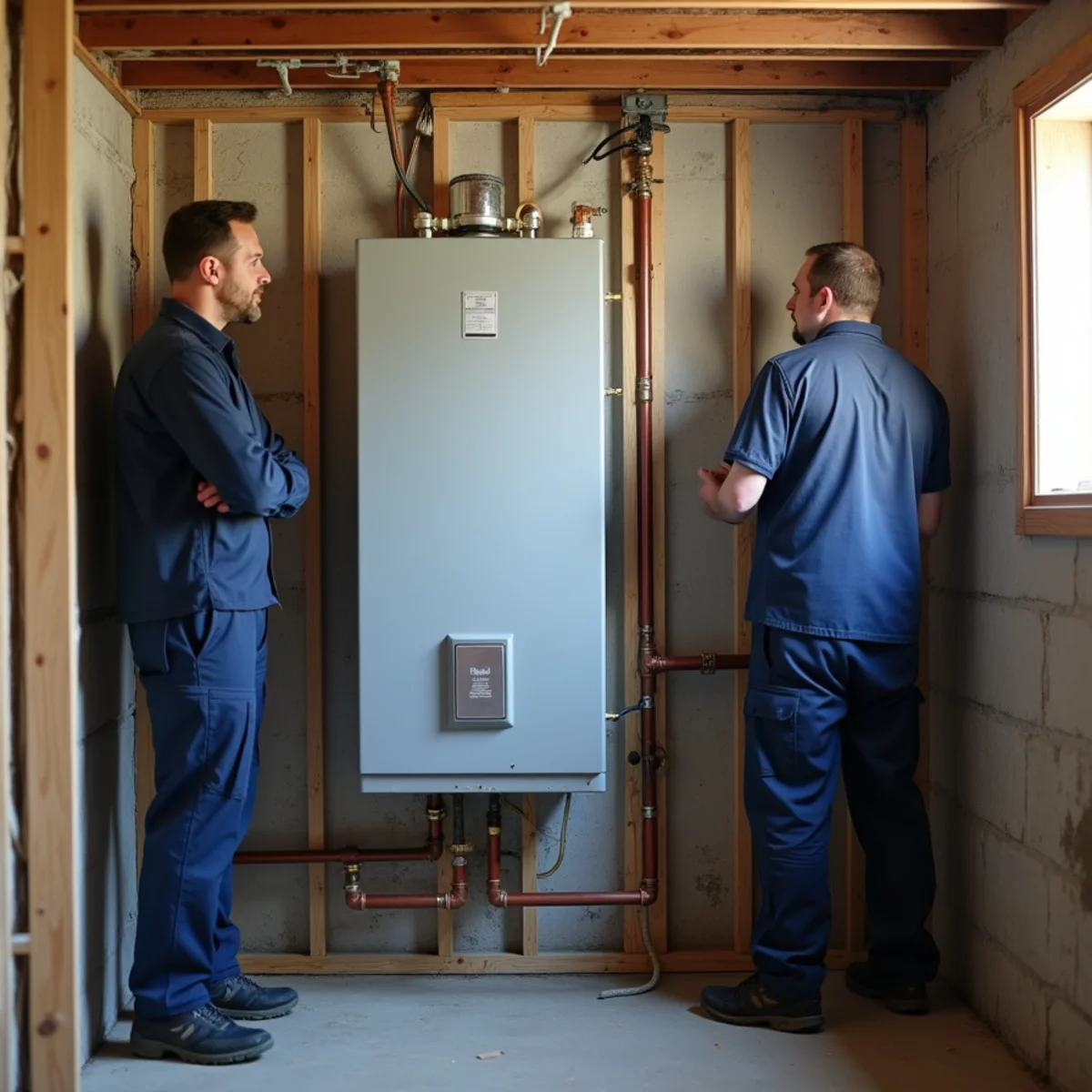
- Space. A wall-mounted box replaces a fifty-gallon drum, which is meaningful in a townhome utility closet or a finished basement.
- Standby energy. You stop paying to keep fifty gallons hot day and night.
- No catastrophic tank failure. There is no reservoir to rust through and dump onto your floor.
The case for a tank
- Lower installed cost, often substantially, because a like-for-like tank swap needs no new gas line or venting.
- Simplicity. Fewer components, cheaper parts, and any plumber can service one.
- No flow ceiling issue. A tank will deliver its full reserve to as many simultaneous fixtures as you want — until it runs out.
- No annual maintenance requirement beyond a flush that is optional (though worthwhile).
- Instant hot at the tap, without the short delay while a tankless unit senses flow and fires.
The two things that decide it in Virginia
1. Your gas line
This is where most bad tankless installs come from. A 50-gallon atmospheric tank burns around 40,000 BTU. A whole-house tankless unit commonly needs 150,000 to 199,000 BTU. That is not a small increase, and the half-inch line that comfortably fed your old tank will not deliver it.
Correct practice is to calculate the total connected load on the meter, measure the developed length of the run, and size the pipe from the tables. Skip that and you get a unit that fires, runs fine on one shower, and then drops out with a flame-failure code the moment the furnace kicks on.
If a tankless bid does not mention the gas line at all, ask why. It is frequently the single largest line item, and it varies enormously house to house.
2. Our water
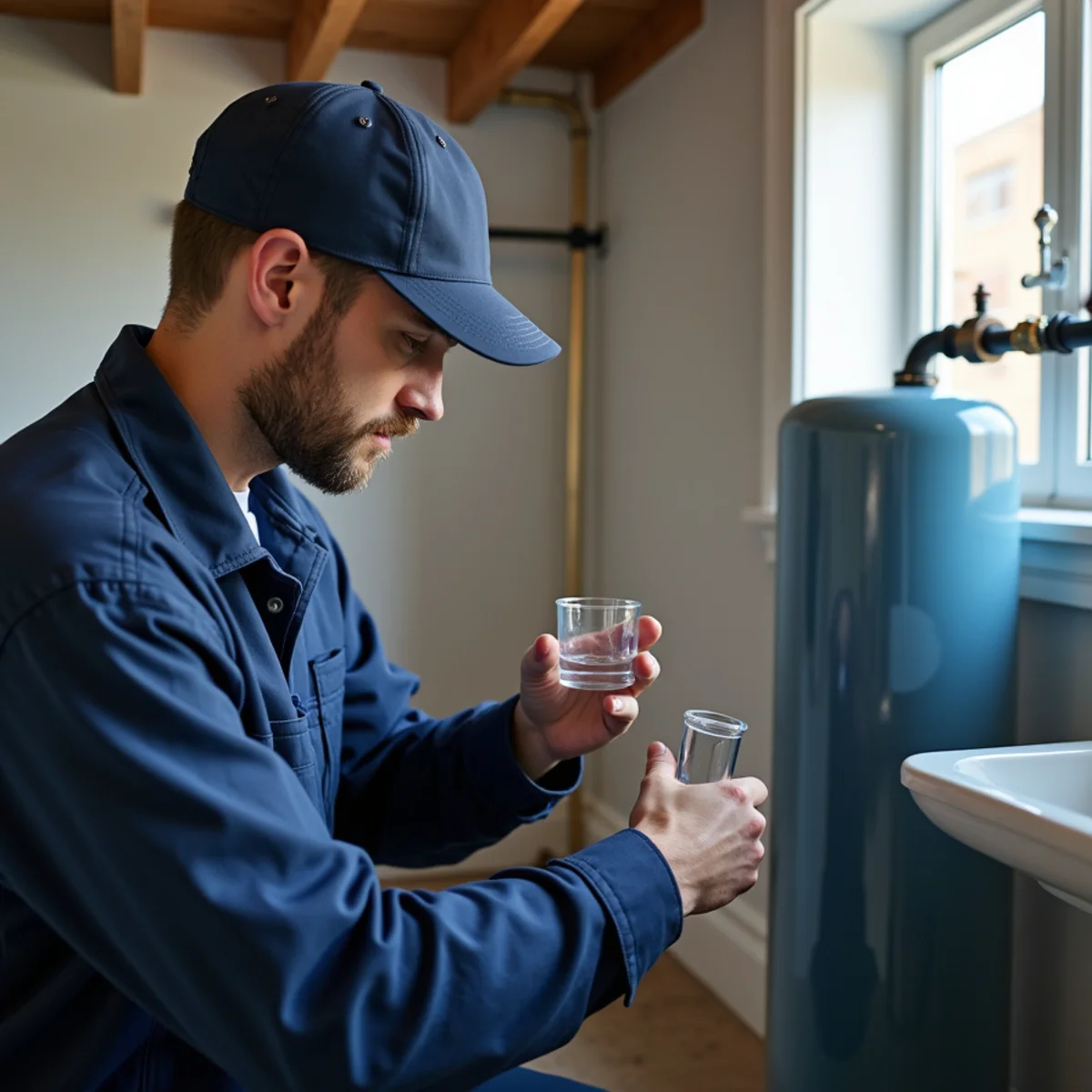
A tankless heat exchanger has narrow passages, and the mineral content in local water coats them faster than it coats a tank's floor. This is not optional maintenance — annual descaling is a genuine requirement here.
The service itself is straightforward: circulating a mild acid solution through the unit for about an hour, which is why we install isolation valves with service ports on every install. Skip it for five years and you get reduced output, error codes, and eventually a heat exchanger replacement that costs more than a decade of maintenance would have.
A properly sized water softener does not eliminate the descaling requirement but it makes each service easier and substantially extends the unit's life. If you are seriously considering tankless, read our guide to hard water in Fredericksburg first.
Sizing for a Virginia winter
A tankless unit's rated flow assumes a given temperature rise. In August, incoming groundwater here might be in the mid-seventies and the unit barely works to reach 120 degrees. In February that incoming water can be in the forties, and the same unit has to work through a 75-degree rise — which cuts its usable flow rate substantially.
A unit sized on the summer number disappoints in January. Any competent installer sizes on winter groundwater temperature. Ask which number was used.
Condensing or non-condensing?
Non-condensing units are simpler and cheaper to buy, run around 80 to 85 percent efficient, and need stainless steel venting because the exhaust stays hot. Condensing units extract additional heat from the exhaust, reach the mid-90s, and vent in PVC — cheaper material and much longer allowable runs — at the cost of producing acidic condensate that needs a drain and a neutralizer.
For most Fredericksburg homes replacing a tank, condensing is the better long-term value, particularly when the venting has to travel any distance to an exterior wall.
The delay, and recirculation
One honest drawback: there is a short wait before hot water arrives, because the unit has to sense flow and fire. In a house with a long run to a distant bathroom, that can feel worse than it did with a tank.
Several units offer a built-in recirculation pump with a small buffer tank, and there are aftermarket options using a crossover valve at the far fixture. Both work and both use some energy. It should be a deliberate choice for your layout, not a default line on every quote.
What about heat pump water heaters?
Worth mentioning because they are frequently the right answer and rarely discussed. A hybrid heat pump unit pulls heat from surrounding air rather than generating it, and uses roughly a third of the electricity of a standard electric tank.
They suit an unconditioned basement or garage with enough air volume, and they cool and dehumidify the space they sit in — a bonus in a Virginia basement in July. They are not right for a small sealed closet. If your home is electric rather than gas, this deserves serious consideration before tankless.
When we tell people not to go tankless
- When the gas meter is already near capacity and the utility upgrade is expensive.
- When the venting path would require going through finished space you care about.
- When you plan to sell within two or three years and will not see the payback.
- When the only motivation is energy savings — those are real but modest. The better arguments are endless hot water, the space, and the twenty-year life.
- When nobody in the household will commit to annual descaling. In this water, that neglect is expensive.
None of that is a knock on the technology. It is the difference between a good installation and a bad one, and the difference is decided before anything is bought.
Related services and areas
If this article describes what you're dealing with, these are the pages that cover the fix.
Frequently Asked Questions
On energy, modestly — you stop paying to keep fifty gallons hot around the clock. The larger financial argument is service life: a maintained tankless unit commonly runs twenty years against eight to twelve for a tank here, so you skip a replacement cycle. If you want a purely financial decision, have someone run the numbers for your household rather than quoting a national average.
Almost always. A 50-gallon tank burns around 40,000 BTU; a whole-house tankless unit commonly needs 150,000 to 199,000. Undersized gas is the number one reason a tankless unit 'never worked right.' If a bid does not mention the gas line, ask why.
Annually, for descaling, given the mineral content in local water. It is not optional here. Proper installs include isolation valves with service ports so the yearly flush is quick. Homes with a water softener can sometimes stretch the interval, but it does not go away.
For a whole house, rarely. Whole-home electric tankless units draw enormous current — frequently more than an average residential panel can supply without an upgrade. They work well for a single remote fixture or a small addition. For whole-house use here, gas is almost always the practical answer.
Want it handled?
Talk to a Licensed Fredericksburg Plumber
Written, itemized estimate before we start. We'll also tell you honestly when the answer is that you don't need us yet.
- 4.8 stars · 26 reviews
- Licensed & insured
- 24/7 emergency service