

Leak detection in Fredericksburg, VA finds the leak before anything is opened. Acoustic listening equipment, thermal imaging and section-by-section pressure isolation narrow a slab or in-wall leak to a small area — so the repair is one precise opening instead of a wall full of exploratory holes.
The expensive part of a hidden leak is almost never the repair. It is the searching. We have been called into houses where a previous contractor opened five sections of wall and never found it — and then found it in twenty minutes with a listening device because the search was structured instead of hopeful.
Start with the meter — you can do this yourself
Before calling anyone, run this test. Turn off every fixture and appliance that uses water, including the ice maker and any irrigation. Go to your water meter and find the low-flow indicator — usually a small triangle, star or dial that spins on very low flow. Watch it for a minute.
If it moves at all, you have an active leak. If it does not, note the reading, come back in an hour with no water used, and compare. This one test separates a real leak from a billing anomaly and it costs nothing.
The usual suspects, in the order we check them
- Toilets. A worn flapper can pass hundreds of gallons a day silently. We put dye in the tank and wait — color in the bowl without flushing confirms it. This is the single most common cause of a mystery water bill.
- Irrigation systems and outdoor spigots. A cracked underground irrigation line or a hose bib leaking behind the siding hides completely.
- Water heater relief valve. A T&P valve weeping into a drain line is invisible unless you look at the termination point.
- Supply lines at fixtures. Braided connectors under sinks and behind toilets fail at the crimp, often into a cabinet floor where nobody looks.
- In-wall and under-slab piping. This is where detection equipment earns its keep.
Slab leaks in Fredericksburg-area homes
A lot of construction in Spotsylvania and Stafford subdivisions from the 1990s onward sits on a slab, with supply lines routed in or under the concrete. When one of those lines leaks, the water has nowhere obvious to go — it saturates the sub-slab fill, and the first signs are subtle.
Warm flooring over a hot water line. A hairline crack appearing in a floor tile. Baseboard that has swelled at the bottom. A carpet edge that stays faintly damp. And the water bill, always the water bill.
How we find them
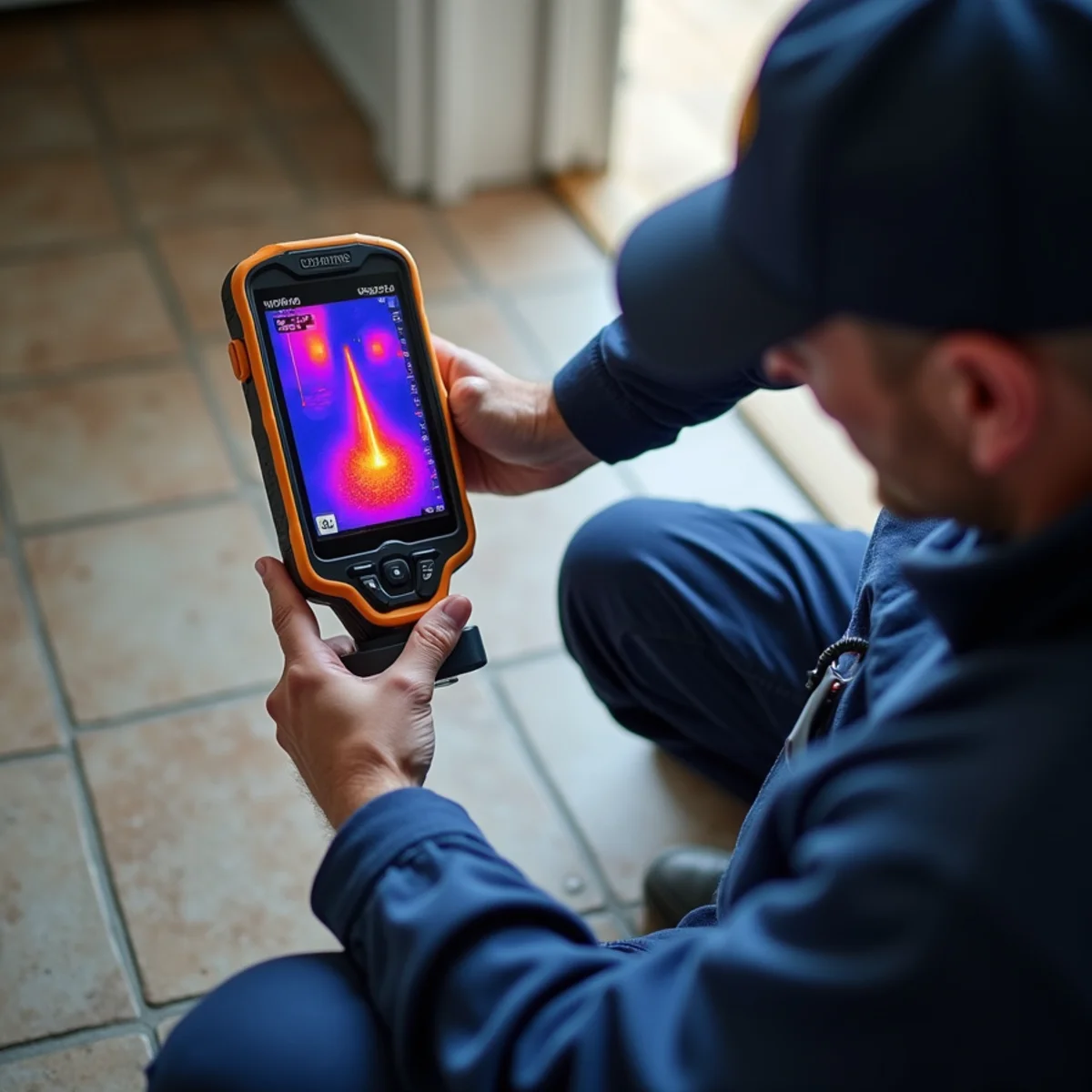
Pressurized water escaping through a small opening makes a distinctive high-frequency sound that carries through concrete. Acoustic detection equipment amplifies it and lets us walk the floor narrowing the location down to within a small area. Where the leak is on the hot side, thermal imaging often confirms it visually. For buried exterior lines, we trace the line path and then listen along it.
How they get fixed
There are three options and the right one depends on the house and the pipe's overall condition.
- Spot repair — open the slab at the located point, repair the pipe, patch the concrete. Least expensive, appropriate when the rest of the system is sound.
- Reroute — abandon the failed section under the slab and run a new line overhead through the attic or through walls. Costs more than a spot repair but takes that run permanently out of the concrete.
- Repipe the branch or the house — when a slab leak is the second or third one, the pipe under the slab is telling you something and chasing individual failures stops being economical.
Pinhole leaks in copper
A pinhole in copper produces a very small amount of water over a very long time — which means the damage is usually discovered long after the leak started. We find them behind ceilings under second-floor bathrooms, in the joist bays over finished basements, and inside wall cavities on exterior walls.
The repair itself is small. What we will always tell you is whether we think it is the first of several, because that determines whether you should be budgeting for a repipe rather than a series of patches.
What documentation you get
If you are making an insurance claim, documentation matters. We note the location, the cause, the pipe material and condition, and photograph the failure before and after repair. Sudden and accidental water damage is frequently covered; long-term seepage frequently is not, and the difference often comes down to how well the failure was documented.
What's included when you book leak detection & repair
Every one of these is part of the job, not an add-on we quote separately once we're in your house.
Confirmation that a leak exists at all
Meter test first. Sometimes the culprit is a flapper or an irrigation zone, and that is a fifteen-minute fix rather than a leak hunt you paid for.
System isolation by section
Closing valves section by section and re-testing narrows the search to hot side, cold side, interior, or the buried service line before equipment comes out.
Acoustic location
Pressurised water escaping a small opening makes a distinctive high-frequency sound that carries through concrete and soil. We walk the floor narrowing it to a small area.
Thermal imaging and line tracing
Thermal confirms hot-side leaks visually; tracing maps buried runs so we know what is under the slab or the yard before anyone cuts.
One opening, in the right place
The entire point of proper detection. Exploratory holes are a sign of searching without equipment behind it.
Insurance-grade documentation
Location, cause, pipe material and condition, photographed before and after. Sudden and accidental damage is frequently covered; long-term seepage frequently is not, and the difference comes down to documentation.
Signs You Need Water Leak Detection & Repair
A water bill that jumped with no change in habits
A leak the size of a pin can move thousands of gallons a month. The bill is often the first and only symptom of a buried or slab leak.
The meter moves with every fixture off
Shut everything down, then watch the low-flow indicator on the meter. Any movement at all means water is going somewhere it should not.
A warm spot on the floor
In slab-built homes, a hot water line leaking under the concrete heats the floor above it. It is one of the most reliable slab leak indicators there is.
Musty smell or a stain that keeps coming back
Paint over a ceiling stain and watch it return — that is an active leak, not a historical one. Recurring musty odor means moisture with no path to dry.
The sound of running water when nothing is on
Especially audible at night. Water moving through a pipe with no fixture open is water escaping somewhere along the way.
How We Handle It
Confirm there is a leak at all
Meter test first. Sometimes the culprit is a running toilet flapper or an irrigation zone, and that is a fifteen-minute fix rather than a leak hunt.
Isolate the system by section
Closing valves section by section and re-testing narrows the search to hot side, cold side, interior, or the buried service line before any equipment comes out.
Locate precisely
Acoustic listening equipment hears pressurized water escaping through concrete and soil. Thermal imaging shows temperature anomalies in walls and floors. Line tracing maps buried runs.
Open once, in the right place
The entire point of proper detection is a single, small, correct opening rather than a wall full of exploratory holes.
Repair and verify
Repair, then re-pressurize and re-test at the meter to confirm the leak is gone — not just the symptom.
What Moves the Price
We don't publish fake numbers, because a firm price quoted before seeing the job is either padded to cover unknowns or revised in your driveway. What we can do is tell you exactly what the estimate depends on, so you can read one and know whether it's fair.
How hard the leak is to find
A visible drip under a sink is not a detection job. A slab leak in a home with tile over concrete and no accessible manifold takes real time and equipment.
Where it turns out to be
Detection cost is largely independent of repair cost. The repair varies enormously — an accessible basement joint versus a line under a finished slab are different worlds.
Repair method for slab leaks
Spot repair through the slab, rerouting the line overhead, or repiping the affected branch. Each has different costs and different disruption.
Finish materials involved
Opening drywall in a laundry room is minor. Opening tile in a renovated bathroom, or cutting a polished concrete floor, is a much larger conversation.
Whether the leak is on the service line
A leak in the buried line between the meter and the house is generally the homeowner's responsibility, and is often better solved by replacing the run than patching it.
Why choose All Pro Plumbing LLC for leak detection & repair
We have been called in after other people gave up
Houses with five sections of wall already opened and no leak found. A structured search with the right equipment finds it in a fraction of the time.
We know what slab construction here looks like
A lot of 1990s-onward Spotsylvania and Stafford building is slab-on-grade with supply in the concrete. Warm floor, hairline tile crack, swollen baseboard — we know the signature.
We separate detection cost from repair cost
Finding it and fixing it are different jobs with different prices, and we quote them separately so you can see what you are paying for.
We tell you when it is the start of a pattern
One pinhole is a repair. Three in eighteen months is a system at end of life, and continuing to patch is money spent on a sequence of small failures.
Licensed & Insured in Virginia · 4.8 stars from 26 Google reviews · Workmanship guarantee on every repair and installation · written itemized estimate before any work begins.
Where we handle leak detection & repair
We run this work across the City of Fredericksburg, Spotsylvania, Stafford, King George and Caroline counties, plus the Northern Neck, the Middle Peninsula and the adjacent counties within realistic driving range — 42 areas we cover for this work. What the job actually involves changes between them: municipal supply downtown versus private wells out toward Caroline, natural gas versus propane, city permits versus county. Pick your area below for the local version.
- Leak Detection & Repair in Fredericksburg
- Leak Detection & Repair in Downtown Fredericksburg
- Leak Detection & Repair in College Heights
- Leak Detection & Repair in Celebrate Virginia
- Leak Detection & Repair in Idlewild
- Leak Detection & Repair in Spotsylvania
- Leak Detection & Repair in Massaponax
- Leak Detection & Repair in Chancellor
- Leak Detection & Repair in Salem Fields
- Leak Detection & Repair in Lee's Hill
- Leak Detection & Repair in Thornburg
- Leak Detection & Repair in Partlow
- Leak Detection & Repair in Stafford
- Leak Detection & Repair in Falmouth
- Leak Detection & Repair in Ferry Farm
- Leak Detection & Repair in Leeland Station
- Leak Detection & Repair in Garrisonville
- Leak Detection & Repair in Aquia Harbour
- Leak Detection & Repair in Hartwood
- Leak Detection & Repair in Widewater
- Leak Detection & Repair in Bowling Green
- Leak Detection & Repair in Ladysmith
- Leak Detection & Repair in Ruther Glen
- Leak Detection & Repair in Port Royal
- Leak Detection & Repair in King George
- Leak Detection & Repair in Dahlgren
- Leak Detection & Repair in Colonial Beach
- Leak Detection & Repair in Montross
- Leak Detection & Repair in Tappahannock
- Leak Detection & Repair in Kilmarnock
- Leak Detection & Repair in Warsaw
- Leak Detection & Repair in West Point
- Leak Detection & Repair in Dumfries
- Leak Detection & Repair in Triangle
- Leak Detection & Repair in Quantico
- Leak Detection & Repair in Woodbridge
- Leak Detection & Repair in Warrenton
- Leak Detection & Repair in Culpeper
- Leak Detection & Repair in Locust Grove
- Leak Detection & Repair in Orange
- Leak Detection & Repair in Lake Anna
- Leak Detection & Repair in Ashland
Leak Detection & Repair Questions We Get Asked
The most reliable indicators are a warm spot on the floor, an unexplained jump in the water bill, the sound of running water with everything off, and new cracks in flooring or drywall. Confirm with the meter test — everything off, watch the low-flow indicator. If it moves, call before the sub-slab saturation causes settlement.
No — finding it and opening it are separate steps. Acoustic detection, thermal imaging and line tracing locate the leak without demolition. We only open once we know where to open, which is the whole point. Exploratory holes are a sign of a search without equipment behind it.
Policies commonly cover sudden and accidental water damage but exclude long-term seepage and the cost of the failed pipe itself. Coverage varies by policy. We document the failure thoroughly — location, cause, pipe condition, photos — which is what your adjuster will want. Call your carrier early rather than after the repair.
Seasonal irrigation, house guests and a new appliance all move the number. What is not normal is a large jump with no change in behavior, or a bill that stays elevated month after month. A pinhole leak can waste thousands of gallons a month silently. The meter test settles it in five minutes.
Yes. Buried irrigation and service line leaks are located by isolating the system at the valves, tracing the line path, and listening along it. Exterior leaks are common in this area because freeze damage to backflow devices and shallow lateral runs shows up in spring, often long after the freeze that caused it.
Related Reading
How to Find a Hidden Water Leak Before It Finds You
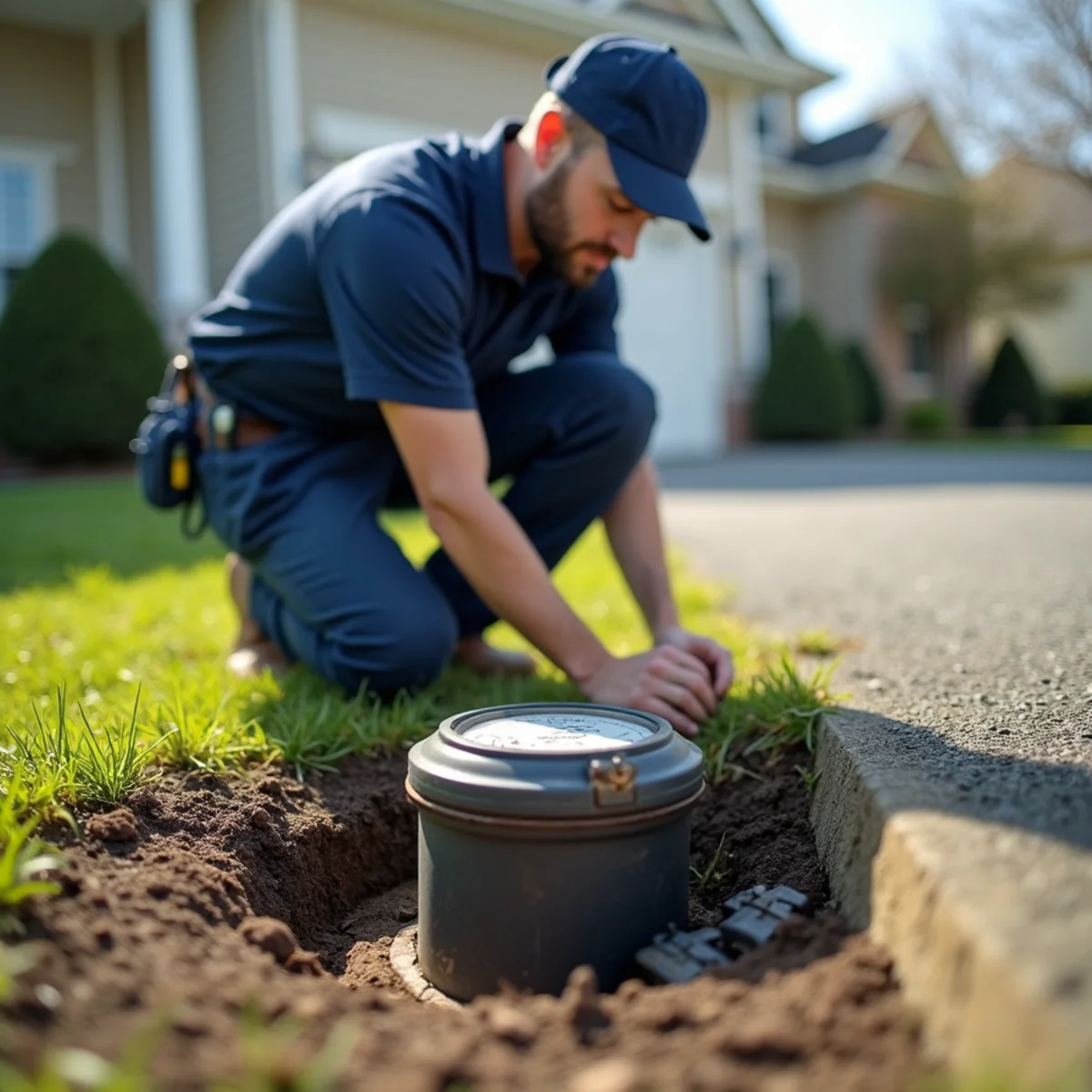
The expensive part of a hidden leak is the searching, not the repair. Here is the structured way to narrow it down — starting with a free five-minute test.
Read the guide →
Low Water Pressure: Causes and Fixes, From Free to Serious
Two questions narrow this down fast: is it everywhere or one fixture, and did it happen suddenly or over years? The answers point straight at the cause.
Read the guide →