
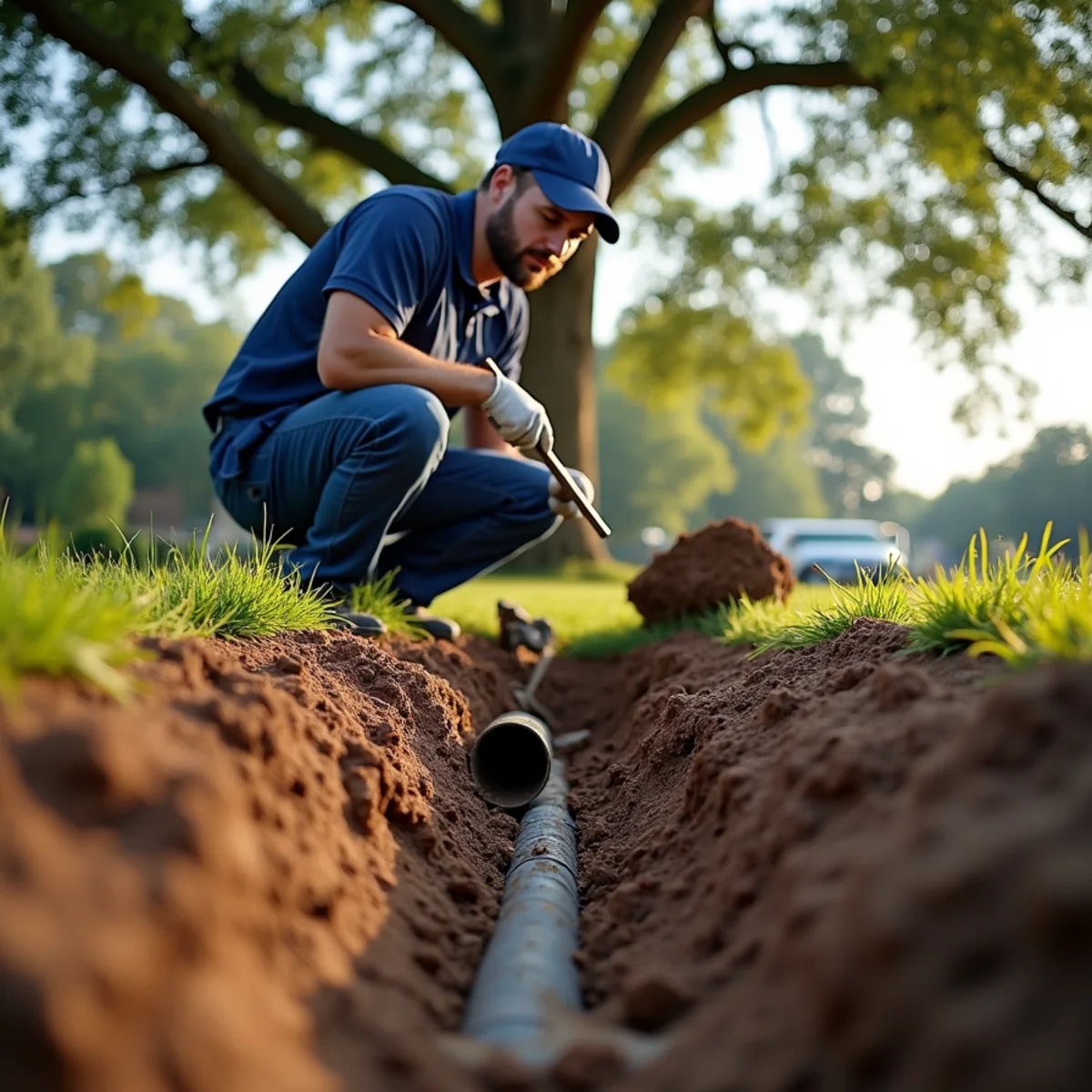
Trenchless sewer repair in Fredericksburg, VA fixes a failing line from the inside, so the yard, driveway and mature trees stay where they are. We camera and locate the defect first, then say honestly whether yours is a lining candidate, a bursting candidate, or a line that genuinely needs open cut.
Trenchless sewer repair rebuilds a failing drain line from the inside, so the pipe gets fixed without a trench running the length of the yard. For a Fredericksburg-area property with a mature tree over the line, a paved driveway on top of it, or a finished basement in the way, that difference usually matters more than the pipe work itself.
It is not a universal answer, and the honest version of this service starts by saying so. Trenchless methods need a host pipe in a particular range of condition. Our job is to camera the line, tell you which category yours falls into, and quote the method that actually fits — including open cut where that is genuinely the right call.
CIPP lining: what it actually is
CIPP stands for cured-in-place pipe. A felt or fibreglass liner saturated with resin is inverted or pulled into the existing pipe, inflated so it presses tight against the host wall, and cured until it hardens. What you end up with is a continuous jointless pipe inside the old one, typically a few millimetres thick, with a smooth bore that flows better than the pipe it replaced.
Because the new pipe has no joints along its length, it removes the thing roots exploit. That is the real reason lining stops recurring root intrusion when cutting never does: there is no longer a seam at the point where the roots were entering.
Pipe bursting: when lining is not enough
Where the host pipe has collapsed, deformed badly or lost too much wall to line against, pipe bursting is the no-dig alternative. A bursting head is pulled through the old line, fracturing it outward into the surrounding soil while simultaneously drawing a new HDPE pipe into the space behind it.
Bursting needs an access pit at each end, so it is not literally dig-free — but two small pits is a different proposition from a trench down the whole run. It also lets you upsize the line, which lining cannot do, since a liner always finishes slightly smaller than the host pipe.
Cast iron drain pipe in older Fredericksburg homes
A large share of the no-dig work around here is cast iron rather than clay. Houses built through the middle of the last century used cast iron for the building drain, and it fails in a characteristic way: the interior tuberculates and scales until the usable bore is a fraction of the original, then the bottom of the pipe channels out and disappears while the top still looks intact from the outside.
That pattern is why a cast iron line can camera badly and still be a good lining candidate — there is often plenty of structure left in the upper half to line against. It is also why descaling matters so much on these jobs. Lining over heavy tuberculation gives you a liner bonded to rust rather than to pipe.
Trenchless versus open cut: how the decision is actually made
The comparison is not simply which method is cheaper per foot. Open cut is frequently cheaper per foot and still the more expensive job once the surface goes back. The things that decide it are what is above the line, how deep it runs, whether the pipe can take a liner, and whether the line needs to be upsized or re-graded.
- A belly or back-pitch is a grading fault — lining preserves the existing slope, so it will not fix it and open cut is the honest answer
- A collapsed section cannot be lined, but it can often be burst
- A line under a driveway, mature tree, patio or finished slab usually favours trenchless on total cost
- A shallow line under open lawn with easy access often favours open cut
- A line that needs to go up a size has to be burst or replaced, not lined
What no-dig work does not fix
Lining restores the pipe, not the grade. If the line has settled into a belly where waste pools, the liner follows that same belly and the pooling continues. Lining also will not resolve an undersized line, a missing cleanout, or a problem that is actually in the municipal main rather than on your side of the connection. Where one of those is the real fault, we will say so before anything is quoted.
Permits and inspections
Sewer work on the private side is permitted work in the City of Fredericksburg and in Spotsylvania, Stafford, King George and Caroline counties, and the requirements are not identical between them. We pull the permit and meet the inspector; you should be suspicious of any sewer quote that treats the permit as optional, because an unpermitted sewer repair becomes your problem at resale.
What's included when you book trenchless sewer repair
Every one of these is part of the job, not an add-on we quote separately once we're in your house.
A recorded camera inspection with an electronic locate
You see the inside of your own pipe and get the depth and position of the defect. No trenchless method should ever be quoted without this.
An honest candidacy call
Lining needs a host pipe with structure left and a consistent diameter. A collapse, a belly or a back-pitch is not a lining job, and we say so rather than sell one.
Proper descaling and preparation
Roots cut back and tuberculation removed so the liner bonds to pipe rather than to rust. This is the step where corner-cutting shows up later as a failed liner.
The method that fits the pipe
CIPP lining where the host pipe can carry a liner, pipe bursting where it cannot and the line needs replacing or upsizing.
A post-work camera pass and the footage
Branch connections reinstated, flow tested, and the finished line recorded. The verification is part of the job, not an add-on.
The permit pulled and the inspection met
Private-side sewer work is permitted in the City and in Spotsylvania, Stafford, King George and Caroline. An unpermitted sewer repair becomes your problem at resale.
Signs You Need Trenchless Sewer Repair & CIPP Pipe Lining
Repeat backups that cabling only fixes for a few months
A line that needs clearing two or three times a year is not a clog problem. Something structural — a crack, a belly, a root intrusion at a joint — is catching debris, and clearing it treats the symptom.
Roots coming back on the camera every spring
Roots enter at joints and cracks. Cutting them is a holding action; they return to the same defect. Lining seals the joint the roots are using, which is why the problem stops rather than pauses.
Cast iron that is scaling or has channelled through
Cast iron drain pipe in older Fredericksburg-area homes typically fails from the inside out — heavy tuberculation narrows the bore, then the bottom channels away entirely. A liner restores a smooth full-diameter pipe inside the old one.
A clay or Orangeburg line in an older neighbourhood
Clay joints separate and Orangeburg deforms into an oval. Both are classic candidates for a no-dig fix, though Orangeburg that has collapsed will need bursting or replacement rather than lining.
The excavation would destroy something expensive
A mature tree, a paved driveway, a finished basement slab, a septic field or a retaining wall. When restoring the surface costs more than the pipe work, trenchless usually wins on total cost even where the pipe work itself is dearer.
How We Handle It
Camera the line and locate the defect
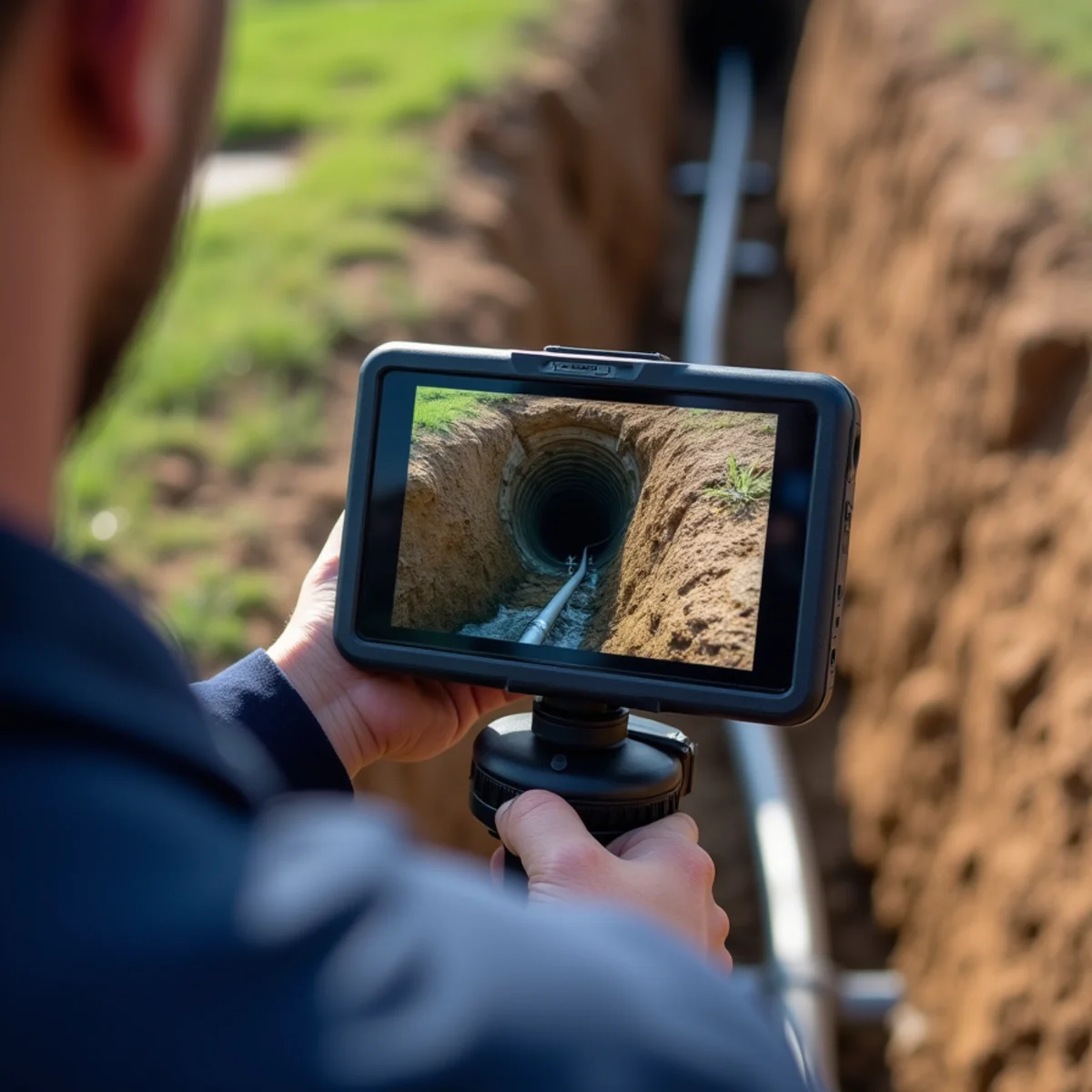
Nothing gets quoted off a guess. We run a camera from the cleanout, record what is there, and electronically locate the depth and position of the problem so you know where it is and how far down.
Say honestly whether it is a trenchless candidate
Lining needs a host pipe with enough structure left to line against, and a reasonably consistent diameter. A fully collapsed line, a severe belly or a line with a back-pitch is not a lining job, and we will tell you that rather than sell you one.
Clean and prepare the host pipe
Descaling or cutting back roots and tuberculation so the liner bonds to a clean wall. This step is where corner-cutting shows up later as a failed liner, so it gets the time it needs.
Install the liner or burst the line
CIPP means a resin-saturated liner inverted into place and cured, forming a new jointless pipe inside the old one. Pipe bursting pulls a new HDPE line through while fracturing the old pipe outward — used where the host pipe is too far gone to line.
Camera it again and reinstate the connections
A post-work camera pass is part of the job, not an extra. Any branch connections are reopened, flow is tested, and you get the footage of the finished line.
What Moves the Price
We don't publish fake numbers, because a firm price quoted before seeing the job is either padded to cover unknowns or revised in your driveway. What we can do is tell you exactly what the estimate depends on, so you can read one and know whether it's fair.
Length of the run and the number of bends
A straight run to the street lines faster and cheaper than one with multiple bends. Sharp offsets can rule lining out entirely.
Host pipe condition
Heavy scaling or root mass means more preparation time before anything can be lined. A line that cleans up quickly costs less than one that fights.
Access points
An existing accessible cleanout keeps the job simple. Where there is no usable access, creating one is part of the work.
Lining versus bursting
Bursting requires access pits at each end and pulls a new pipe through, so it carries excavation the lining method avoids. Which one applies is decided by the camera, not by preference.
Depth and what is on top of it
Depth drives the cost of any pit that is needed, and whether the route crosses a driveway, a utility or a county right of way changes the permitting and reinstatement.
Why choose All Pro Plumbing LLC for trenchless sewer repair
We will tell you when trenchless is the wrong answer
A belly is a grading fault and a liner follows the same grade, so it will not fix one. Companies that only sell trenchless rarely volunteer that.
We know the local cast iron failure pattern
Mid-century housing stock here fails from the inside out — the bore tuberculates, then the invert channels away while the top still looks sound. That pattern decides whether lining will hold.
You see the camera footage before and after
Both passes, handed over. A trenchless quote built on a verbal description of the problem is not a quote you should accept from anyone.
Open cut stays on the table
We do both, so there is no incentive to push the method that suits our equipment rather than your pipe.
Licensed & Insured in Virginia · 4.8 stars from 26 Google reviews · Workmanship guarantee on every repair and installation · written itemized estimate before any work begins.
Where we handle trenchless sewer repair
We run this work across the City of Fredericksburg, Spotsylvania, Stafford, King George and Caroline counties, plus the Northern Neck, the Middle Peninsula and the adjacent counties within realistic driving range — 42 areas we cover for this work. What the job actually involves changes between them: municipal supply downtown versus private wells out toward Caroline, natural gas versus propane, city permits versus county. Pick your area below for the local version.
- Trenchless Sewer Repair in Fredericksburg
- Trenchless Sewer Repair in Downtown Fredericksburg
- Trenchless Sewer Repair in College Heights
- Trenchless Sewer Repair in Celebrate Virginia
- Trenchless Sewer Repair in Idlewild
- Trenchless Sewer Repair in Spotsylvania
- Trenchless Sewer Repair in Massaponax
- Trenchless Sewer Repair in Chancellor
- Trenchless Sewer Repair in Salem Fields
- Trenchless Sewer Repair in Lee's Hill
- Trenchless Sewer Repair in Thornburg
- Trenchless Sewer Repair in Partlow
- Trenchless Sewer Repair in Stafford
- Trenchless Sewer Repair in Falmouth
- Trenchless Sewer Repair in Ferry Farm
- Trenchless Sewer Repair in Leeland Station
- Trenchless Sewer Repair in Garrisonville
- Trenchless Sewer Repair in Aquia Harbour
- Trenchless Sewer Repair in Hartwood
- Trenchless Sewer Repair in Widewater
- Trenchless Sewer Repair in Bowling Green
- Trenchless Sewer Repair in Ladysmith
- Trenchless Sewer Repair in Ruther Glen
- Trenchless Sewer Repair in Port Royal
- Trenchless Sewer Repair in King George
- Trenchless Sewer Repair in Dahlgren
- Trenchless Sewer Repair in Colonial Beach
- Trenchless Sewer Repair in Montross
- Trenchless Sewer Repair in Tappahannock
- Trenchless Sewer Repair in Kilmarnock
- Trenchless Sewer Repair in Warsaw
- Trenchless Sewer Repair in West Point
- Trenchless Sewer Repair in Dumfries
- Trenchless Sewer Repair in Triangle
- Trenchless Sewer Repair in Quantico
- Trenchless Sewer Repair in Woodbridge
- Trenchless Sewer Repair in Warrenton
- Trenchless Sewer Repair in Culpeper
- Trenchless Sewer Repair in Locust Grove
- Trenchless Sewer Repair in Orange
- Trenchless Sewer Repair in Lake Anna
- Trenchless Sewer Repair in Ashland
Trenchless Sewer Repair Questions We Get Asked
Most residential lining jobs are completed within a day once the line has been cleaned and prepared, and the resin needs curing time on top of that. The variables are how much preparation the host pipe needs and whether access has to be created. Bursting is usually a day as well, plus the pits. We give you the timeline after the camera inspection, not before it.
For a line that is a genuine lining candidate, the result is a jointless pipe with a smooth bore and no seams for roots to enter, which is in several respects better than the pipe it went inside. What it cannot do is change the grade or the diameter. If your problem is a belly or an undersized line, replacement is the better answer and we will tell you that.
That is the point of the method. Lining typically works from an existing cleanout with no excavation at all. Bursting needs a small pit at each end rather than a trench along the whole run. Where the line passes under a driveway, mature trees or a patio, this is usually the difference between a repair and a reconstruction project.
Often yes, and it is one of the more common applications in older homes around Fredericksburg. Cast iron usually keeps enough structure in the upper half of the pipe to line against even when the bottom has channelled out. It has to be properly descaled first — lining over heavy tuberculation gives you a liner bonded to rust, not to pipe.
A camera inspection with an electronic locate. That tells us the material, the diameter, the depth, where the defect is and what condition the surrounding pipe is in — which is everything the method decision depends on. We will not quote a trenchless repair without one, and you should see the footage.
Related Reading
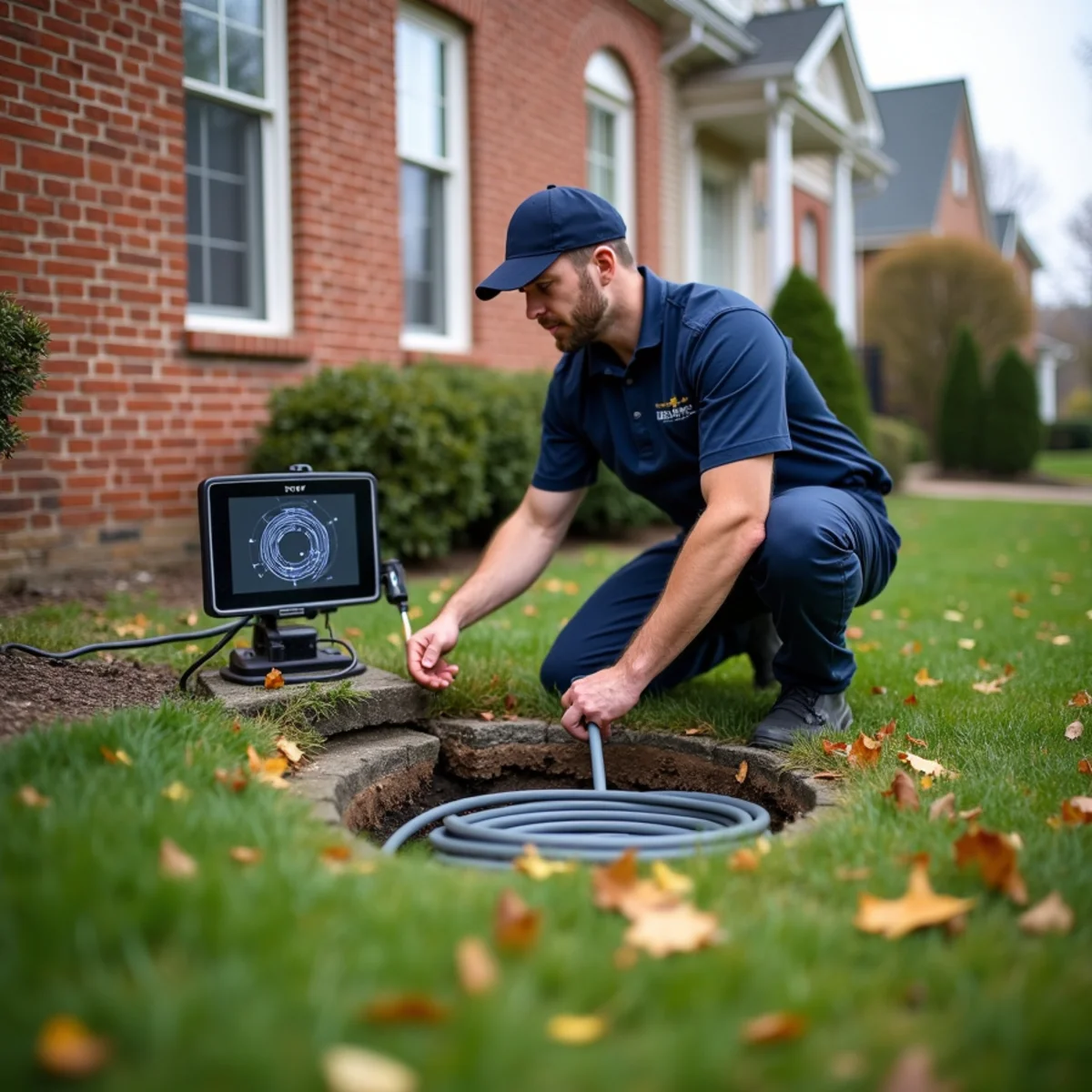
Why Your Drain Keeps Backing Up After It Was Just Cleared
If a line needs clearing two or three times a year, clearing it is not the fix. Here is what is actually holding the debris, and how to find out which one you have.
Read the guide →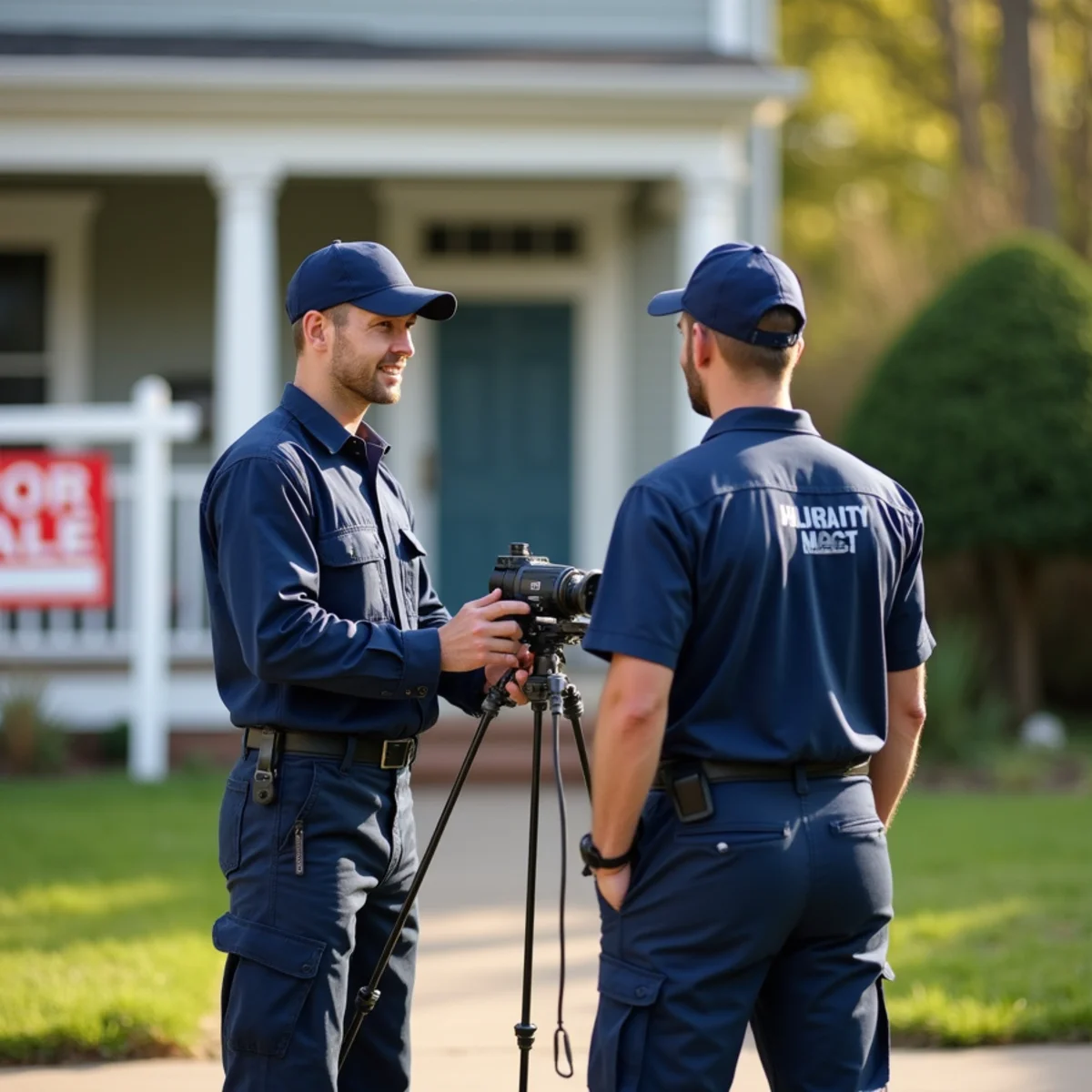
Why You Should Camera the Sewer Before Buying an Older Home
Standard home inspections do not include the sewer lateral. It is the single most expensive thing a buyer can inherit, and it is invisible on walkthrough day.
Read the guide →
Replacing Galvanized Pipe in a Historic Home: A Practical Guide
The pipe is the easy part. Getting a new system into a 120-year-old house without wrecking what makes it worth owning is the actual job.
Read the guide →