The short answer
Disconnect every garden hose, insulate exposed supply runs in crawl spaces and garages, close crawl space vents, and make sure every adult knows where the main shutoff is. Virginia's freezes are short and irregular, which is exactly why local plumbing was never protected the way northern plumbing is.
Every January we run a wave of burst pipe calls, and the striking thing is how similar they are. The same three or four failures, repeated across dozens of houses, almost all of them preventable with an afternoon of work in November.
The reason is structural. Because deep freezes in this part of Virginia are short and irregular, a lot of local plumbing was simply never protected the way it would be in a colder climate. Crawl space runs go uninsulated. Hose bibs are standard rather than frost-free. Garage walls carry supply lines with siding as the only barrier. One hard night finds all of it at once.
Where pipes actually freeze around here
In order of how often we find them:
- Hose bibs and outdoor spigots. A standard bib holds water right at the wall. If a garden hose is still connected, that water cannot drain — and when it freezes, the pipe splits, usually inside the wall.
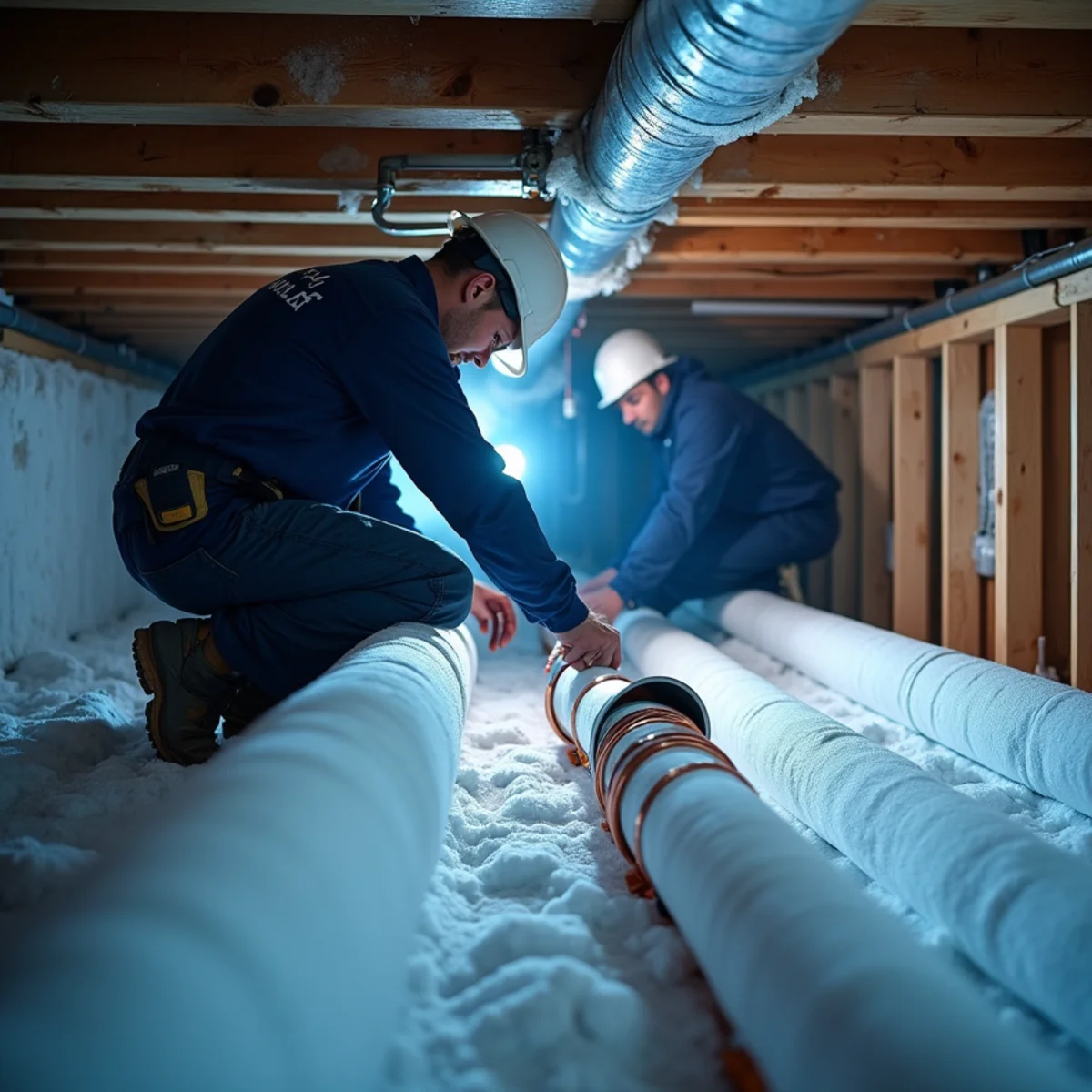
- Crawl space runs. Uninsulated supply lines in a vented crawl space are exposed to outside air temperature with nothing between them and it.
- Garage and exterior wall runs. Supply lines routed through a wall with minimal insulation, particularly on the north side of a house.
- Unheated additions, sunrooms and bonus rooms over garages. Spaces that were finished without extending the heating system properly.
- Well houses and outbuildings on rural properties, where a heat source failed and nobody noticed.
Before the cold: the November checklist
Disconnect every garden hose
This is the highest-value ten minutes in the entire list. A connected hose traps water in the bib, defeats the drainage the fixture depends on, and turns a normal freeze into a split pipe inside your wall. Do it for every hose on the property, including the one behind the shed you forgot about.
If your hose bibs have an interior shutoff, close it and open the bib outside to let the section drain.
Insulate exposed runs
Foam pipe sleeve from any hardware store, cut to length and taped at the joints. Cover every supply line you can see in a crawl space, garage, unheated basement or exterior wall cavity. It costs very little and it works.
Pay particular attention to the run feeding an outdoor spigot and to any pipe near a foundation vent, which is effectively a hole letting winter air blow directly across it.
Close crawl space vents
If your crawl space has manually operated vents, close them for winter. If they are automatic, verify they actually close. An open vent on a windy fifteen-degree night is the difference between a pipe at forty degrees and a pipe at twenty.
Seal air leaks
Look for gaps where pipes, cables or ducts penetrate exterior walls, sill plates and rim joists. Spray foam or caulk. A surprising number of frozen pipe calls trace back to a hole the size of a fist letting outside air blow directly onto a supply line.
Find your main shutoff
Do this today, on a calm afternoon, not at midnight with water coming through a ceiling. Locate it, confirm it turns, and make sure every adult in the house knows where it is and can operate it.
In most local homes it is where the supply enters the basement or crawl space, often near the water heater. In slab-built homes in Spotsylvania and Stafford subdivisions it is frequently in a garage wall or utility closet. If yours is seized or you cannot find one at all — which is common in pre-1960s houses — that is worth fixing before winter.
During a cold snap
When the forecast drops into the teens:
- Open cabinet doors under kitchen and bathroom sinks on exterior walls, so heated room air can reach the pipes.
- Let a vulnerable faucet drip. Moving water freezes more slowly, and an open faucet relieves the pressure that actually bursts pipes. A pencil-lead stream is enough.
- Keep the thermostat at a consistent temperature day and night. The savings from setting back at night are not worth the risk during a hard freeze.
- If you are leaving town, do not set the thermostat below about 55 degrees, and have somebody check the house.
- Keep the garage door closed if supply lines run through the garage.
If a pipe freezes
You will know because a faucet produces nothing or a thin trickle while others work normally. Act quickly — a frozen pipe has not necessarily burst yet, and thawing it carefully can prevent that.
- Open the affected faucet. This gives melting water somewhere to go and relieves pressure.
- Find the frozen section. Follow the line back from the fixture toward the source, feeling for a very cold spot or looking for frost on the pipe.
- Apply gentle heat. A hair dryer, a heating pad, warm towels, or a space heater aimed at the area. Work from the faucet end back toward the frozen section, never the reverse.
- Never use a torch, propane heater or heat gun. This is how a frozen pipe becomes a house fire, and it happens every winter somewhere.
- If you cannot find it, cannot reach it, or the pipe has already split — shut off the main and call.
If it burst
Shut off the main immediately. Then kill power to the water heater and to any circuit in the affected area if water is near electrical. Move anything valuable clear. Then call for emergency plumbing service.
One thing worth knowing: when we repair a frozen break, we pressure-test the affected run before calling it fixed. It is common to find a second split ten feet away that has not started leaking only because the ice is still holding it closed.
Permanent fixes worth making
If the same pipe freezes twice, insulation is not the answer — something structural needs to change.
- Convert standard hose bibs to frost-free sillcocks, which place the valve seat a foot or more inside the heated envelope so the exposed section drains empty.
- Reroute a chronically vulnerable run into conditioned space. During a repipe this costs almost nothing extra and permanently removes the problem.
- Add heat tape with a thermostat to a run that genuinely cannot be relocated.
- Encapsulate or insulate the crawl space properly rather than fighting it every winter.
PEX is also worth mentioning here: it expands with the ice and usually recovers rather than splitting, which is one reason we recommend it for runs in vulnerable locations during a repipe.
Related services and areas
If this article describes what you're dealing with, these are the pages that cover the fix.
Frequently Asked Questions
Pipes in unheated spaces are at risk below about 20 degrees Fahrenheit, though it depends on wind, duration and how exposed the run is. In Virginia the danger is that our freezes are short and irregular, so plumbing here often was not protected the way it would be in a colder climate — one hard night finds all of it.
For vulnerable fixtures on exterior walls, yes. Moving water freezes more slowly, and more importantly an open faucet relieves the pressure that actually bursts pipes — pipes usually split from pressure between the ice blockage and the closed tap, not from the ice itself. A pencil-lead stream is enough.
Open the affected faucet first, then apply gentle heat with a hair dryer, heating pad or space heater, working from the faucet end back toward the frozen section. Never use a torch, propane heater or heat gun — that is how a frozen pipe becomes a house fire.
A classic freeze split. A standard hose bib holds water right at the wall, and a connected hose prevents it from draining — so the trapped water froze, expanded and split the pipe inside the wall. You find out in spring when you turn it on. Converting to a frost-free sillcock removes the failure mode.
Want it handled?
Talk to a Licensed Fredericksburg Plumber
Written, itemized estimate before we start. We'll also tell you honestly when the answer is that you don't need us yet.
- 4.8 stars · 26 reviews
- Licensed & insured
- 24/7 emergency service